"The trick is not to mind."

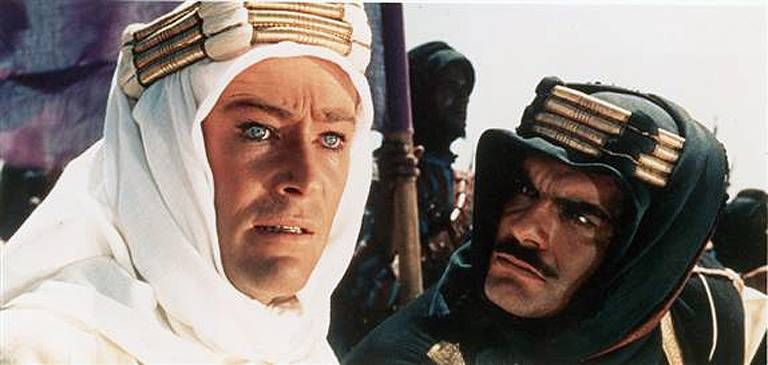
Lawrence of Arabia and Rebellion
This might just actually be an excuse for me to talk about Omar Sharif and how he is the handsomest man to exist (sorry, folks, its not Henry Cavill and his weird neck).
Ok, now that I've frightened off half of my readers, I want to talk about Lawrence of Arabia and rebellion. Or, rather, the feel-good aims of the film and the sickly after effect that it leaves. I dreaded watching the movie. Like most modern day people, I assumed it was about a white man teaching Brown people how to succeed. And it is, on surface level.
What struck me as I watched it was , not only the gorgeous cinematography and how director David Lean's images became the language of cinematography in the desert, but how it was actually about how we build narratives of ourselves, and our nation (and, of course, the queer romance between Lawrence and Ali). I'm not at all interested in the real Lawrence. No desire to read Seven Pillars of the World or whatever its called. I am interested in the film's Lawrence, who is both a character and a narrative device.
The films opens with Lawrence racing his bike through the English countryside, daringly, recklessly. He dies and the film shifts to St. Paul's, where his funeral are held. Instead of being told how wonderful he was, my expectation, most of the people, whom we meet in the film later, talk about what a shitheel he was. Grandiose and aggrandizing. A liar and a cheat.
The film is telling you not to like Lawrence and not trust what you are about to see. Lawrence is the protagonist of this film, but he's not the hero. No, that's Sherif Ali, played by Omar Sharif.
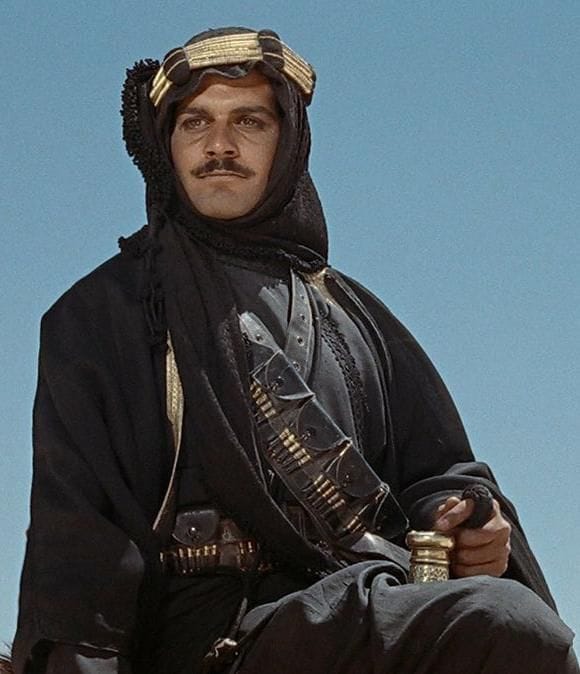
Ali never wavers from his mission. He believes in the fundamental right of the Arabs to self-govern. He is deeply baked into his culture, which we see in the well scene. He is a devout Muslim. He is a leader and he does not believe in cruelty. Which is the rub between him and Lawrence because Lawrence becomes deeply fearful after being tortured in Deraa and who does not believe in his own mission. Only in his own divinity.
Ali, to his credit, never believes in his own divinity. He may believe that El Aurens was sent by Allah to help, but he believes thing are as Allah wills it. When Lawrence becomes impressed, literally, with the limitations of his body, he flees. Ali holds the ground. And he never engages in cruelty, which Lawrence does at the end.
Lawrence betrays every word that he spoke in Feisel's tent at the beginning, before the march to Aqaba. Ali never does. We are primed to see Lawrence as the hero because he is white, but the narrative drives at us time and time again to see him as a liar and untrustworthy.

The key scene that I'm thinking of is when Lawrence returns to General Allenby in his uniform, before the march on Damascus. He wants to quit. I don't want to be part of your big push, he cries, shaking, tears nearly dripping down his long face. My 2nd favorite character of the entire film, Claude Reins's Dryden, steps forward and notices the blood on Lawrence's back. He calls out to Lawrence, who turns to face him and Allenby sees the blood, understanding flooding his face.
He takes Lawrence out for a drink and points out that only Lawrence can do what he needs to do. That only Lawrence make the push to Damascus successful. He rebuilds Lawrence's narrative of himself as the divine. "Only I can do it. I can give them Damascus."
An incredible moment (not nearly as incredible as Dryden who reminds Lawrence that a man who tells half lies has forgotten where he puts the truth (one of the most poignant and incisive scenes and Reins nails it. Honestly, after watching him in Lawrence and going back to Casablanca was a revelation)).
Lawrence, of course, fails with Damascus. They get it, but do they get to keep it? (The same scene above lays the ground for the failure). There is only the desert for you, Lawrence. The story you told about yourself, the version of yourself that you created, lives there and cannot live outside of its context.
All rebellions have an ideological birth. We are in the midst of an ideological upheaval in America. The idea of America has always existed in the narrative it has told itself: that we are exceptional; that we are the only extant democracy; that we can do great things; that we resist rule from above. Lawrence's narrative crumbled and he learned he was only made of clay. Will our narrative withstand the scrutiny or will we have forgotten where we put the truth?
My favorite scene. And the egregious brownface that populates the entire film.


