Sinners in the Hand of an Angry Paw

CW: God
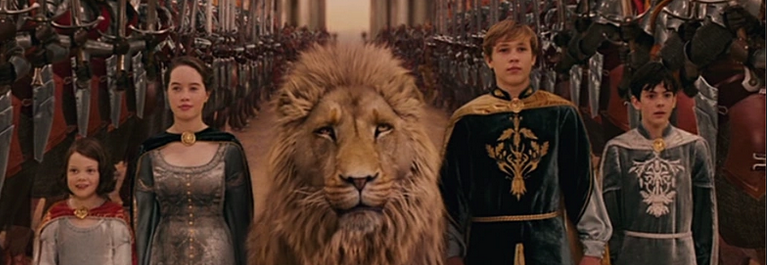
I've recently re-read all the Narnia books. I'm looking for copies as all I have is Lion, Witch, and Wardrobe (LWW) and I promise this will not become a rant on how angry I am about the death of mass market paperbacks. I've read some lovely pieces on these books. I've definitely fallen for Puddleglum and Jill Pole. Silver Chair was such a bore as a child and such a delight as a middle aged woman.
But there are problems with this world that heap me and task me.
First of all, who is putting a sword in the hand of a 13 year old? Making two 13 year olds king? (Peter in LWW, and Caspian in Prince Caspian. Do not rely on the movie. It made regrettable and anti-text choices)
How much do they remember when they go back? (The opening of Caspian tells it was like a dream. But clearly they do remember it afterwards as Eustace teases them about it, and because Peter tells us in The Last Battle that they get together to talk Narnia) The Pevensies lived to be in their late 20s in Narnia, and Peter maybe reached the same age again before the serious accident on the British railway took them all out.
Narnia is about grief. Perhaps God is about grief.
Lucy has the burden of prophecy. The poesis of it.
Peter is the rock upon which Aslan builds his Golden Age, and all thereafter, even though Lewis explicitly calls Frank and Helen the Adam and Eve of Narnia. Peter is the foundation stone. Peter is the one who closes the door.
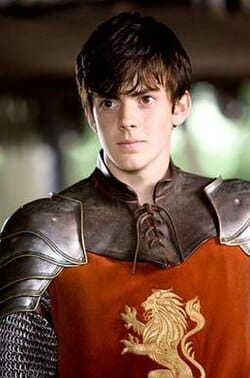
Edmund is the doubter and the returner.
Susan is the lost sheep.
And the Narnians are mere puppets in Aslan's grand world. Did he not try to send for other human children before, during the one hundred years of winter? Why did it take one hundred years for it to end?
These are the questions Susan asked, I'm sure, and which got her banished. Narnians were left to suffer. Why were the Pevensies the key element to destroy Jadis? Because of a prophecy? How is a god bound by a prophecy?
The Narnians are sinners in the hand of an angry paw.
“There is nothing that keeps wicked men at any one moment out of hell, but the mere pleasure of God.”—By the mere pleasure of God, I mean his sovereign pleasure, his arbitrary will, restrained by no obligation, hindered by no manner of difficulty, any more than if nothing else but God’s mere will had in the least degree, or in any respect whatsoever, any hand in the preservation of wicked men one moment."
Jonathan Edwards's sermon "Sinners in the Hand of an Angry God" posits that it is only God's grace that keeps man from following his own natural inclinations into hell. He means a true and literal hell. I've always argued that hell itself is a condition, an absence of God.
Are Narnians not in hell in one hundred years of winter? Why must their grace rest on one hundred years and not earlier?
God has laid himself under no obligation, by any promise to keep any natural man out of hell one moment. God certainly has made no promises either of eternal life, or of any deliverance or preservation from eternal death, but what are contained in the covenant of grace,
Aslan is not a tame lion, the Beavers tell Lucy (its Mr. Tumnus in the film). He rules by claw and by fiat and by sacrifice. Remember, he attacks Bree in The Horse and His Boy for his vanity. He claws Aravis for causing her servant girl to be beaten. And he turns Rabadash into an ass, into prey, into a working animal. He punishes and he delights. Shasta goes through all of his troubles, simply to be crowned king. He punishes them for their transgressions against others, and in doing so, against him (this is not a Jewish conceit).
I do think Lewis was troubled by Aslan's own lack of involvement and that the answer is somewhere in how the Beavers tell the children that he has other countries to manage (a negligent God? then not omniscient). Or that there is an unwanted traveler. The imagery of Shasta traversing across the mountain at night in a deep fog with a presence beside him. When the sun rises, it is revealed that the horse he was riding traveled on a narrow ledge and only the presence kept him from falling into a chasm.
A sinner in the hand of an angry paw.
Edwards's argument has always been that we are all sinners and it is only by God's hand that we are not fallen into flames. No one deserves to be saved, nor does God promise salvation.
A hand (paw) that is a shield.
But a paw that has no obligation to his own people. Perhaps that is why he must wait for the Pevensies, to be his instrument, which is also an unsettling argument because of the ultimate end of Susan. Lewis also insisted that this wasn't an allegory, so we cannot write this on God as if a palimpsest , so that God's own actions explain Aslan.
Narnia is about grief and coming to terms with grief and sometimes, that means coming to terms with what it means to be our own grace.
I've tried chatting with this about others, but it gets deep into the weeds, and into personal beliefs so I apologize for thrusting this upon you. But do let me know your thoughts.
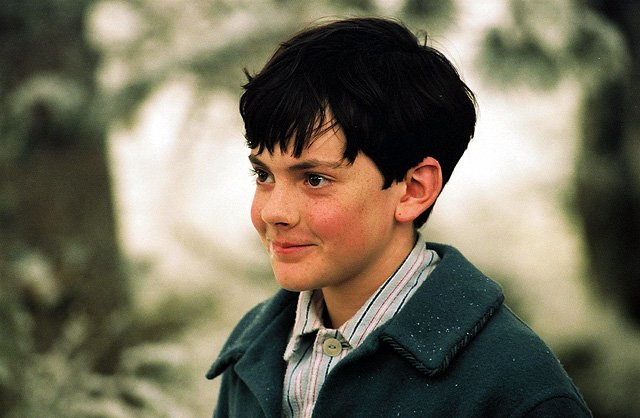
Also, Edmund is a sweet, innocent babe who, yes, was experiencing World War 2 sugar rationing but the Turkish delight was freaking enchanted. It was Plato's perfect form of Turkish delight, designed to lure him again. He was drugged, yo! Leave my baby alone!
I also have some thoughts about the Pevensies and Lawrence of Arabia, but I need to find my Said.
As in terms of my re-read, as a child, I adored The Horse and His Boy. That adoration did not survive a re-read as an adult. The Orientalism, the misogyny, the fatphobia were too much. The fatphobia in Silver Chair was truly annoying. What is with British children's authors and associating fat with evil? The Voyage of the Dawn Treader is still quite high up there and Prince Caspian is so much better than the movie. Yes, Ben Barnes is handsome but he's like 20 and Caspian was 13 and why did Peter need to be a little shit? Not very magnificent behavior there, Pete.
Might re-read His Dark Materials next, since we are grappling with interpretations of God. Might not.
What's on your tbr?


