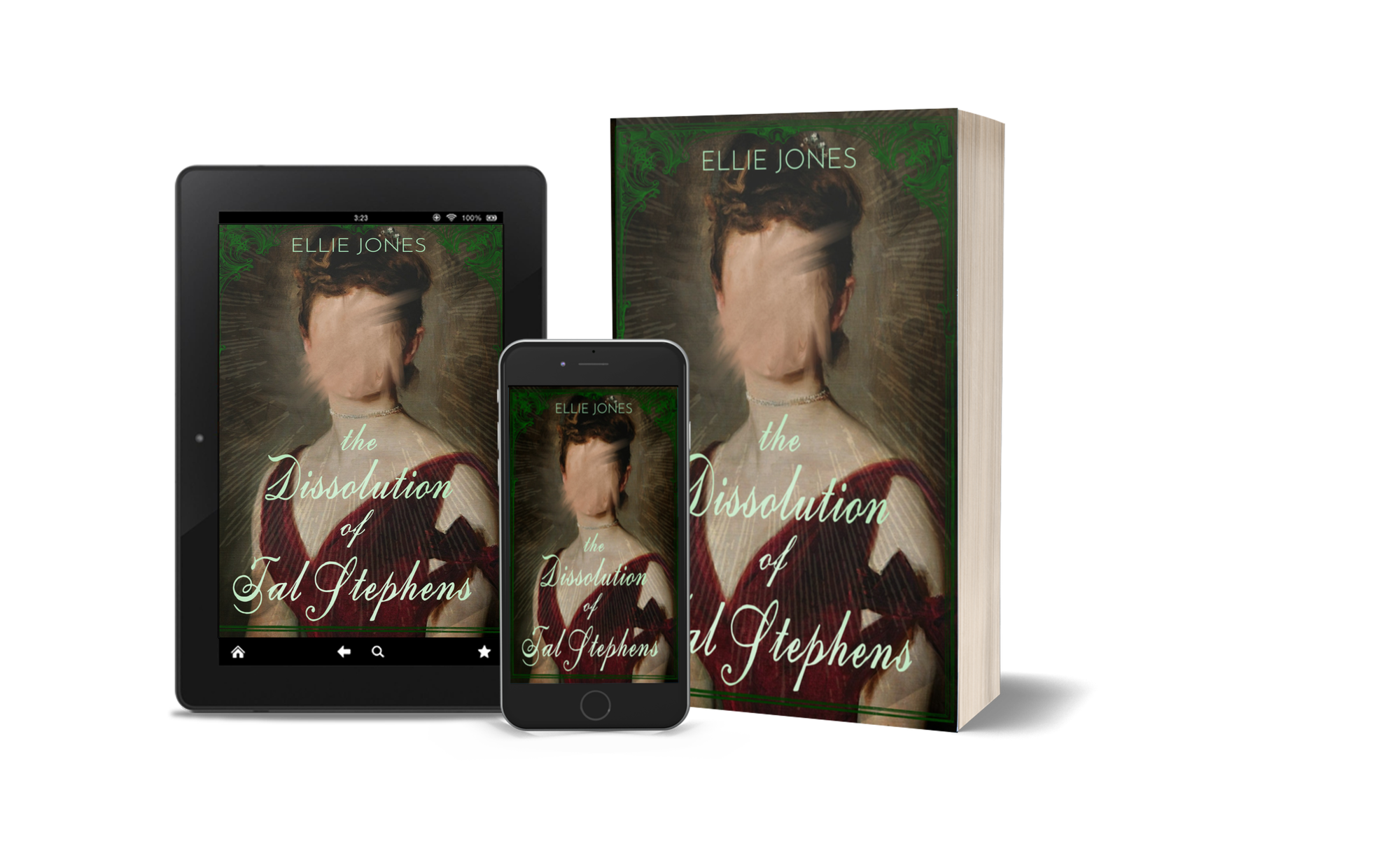
Preview -The Dissolution of Tal Stephens

We're 2 weeks plus some change until the release of Tal.
Please enjoy the first chapter of The Dissolution of Tal Stephens, available September 29th.
You can buy it here.

New York City - 1897
The body on the morgue table could have easily been hers. A twenty-five year old woman, callused hands, ashy knees, and cropped hair. But this woman was a cold corpse whose scalp Tal was carefully stitching back together. Behind her, Remy St. Clair, doctor of forensic philosophy at Columbia, lectured grandly to a handful of other forensic philosophers about procedures that could have saved the woman’s life.
“With new aetheric technology increasing the power of spectrographs, we can more easily scan inside the skull to find cause of death,” he boasted, a near repeat of his latest paper that probably hadn’t been read by either of his interlocutors.
“A waste of money,” one scientist sneered.
“What further knowledge would that offer us to offset the cost?” another contested. They would be here all day, at this rate. Tal took a deep breath and adjusted the sheet covering the woman.
Katie Connolly, Tal’s magic told her, even if the intake form had not. The police had found her slumped on a stoop, dead, most likely from the blow to her head.
They had no reason to investigate the woman’s death, not without a bit of coin, but Tal couldn’t help it. Her uncanny always showed her someone’s life, a cinematograph that she never wanted to witness. Katie’s life had been a hard one. Too much work, too little pay. Her belly was full of corrupted brew, joints aching from a day of scrubbing floors, the promised wages not enough to secure a flop. She had missed the crack in the sidewalk and plowed into the corner of a building. The resulting pain and tacky blood had driven her into a doorway, into a sleep from which she would never wake.
If Tal were the praying sort, she might have offered something to the gods, but Katie’s memories would live in Tal forever and that would have to be prayer enough.
Remy continued arguing with the other doctors. This sort of conversation was expected at the 1897 Bi-annual Convention for Forensic Philosophy and the Mortuary Arts. Tal’s magic hummed unpleasantly beneath her skin and Katie’s fingers twitched in response. Time to get out of there. She didn’t need an accidental resurrection.
Tal washed her hands before tidying up. Lacking any true credentials, she was merely Remy’s assistant, and her work was done for the day. She had the afternoon to explore the rest of the convention hall, which sounded far more appealing than listening to men squabble. If it were about death, she might stay and listen, but it was mostly about their egos, and she had heard plenty of that already.
Tal gave orders to have Katie’s body shipped to the university’s lab immediately. Remy would want to use Katie for other experiments, and Tal had been Remy’s assistant long enough to understand what needed to be done without being explicitly told. She slapped her hat on her head and slipped out the side door, leaving the bickering behind.
The guards at the corridor entry way examined her pass before unlocking the door with a runic key, something the Order of the Sacella had crafted to protect their area from unsuspecting visitors. Nothing like visiting a fair to explore technological advancements and stumbling upon dissected bodies. They were shunted off to a wing at the back of the building, but the organizers had included several wards out of an abundance of caution.
Once outside the wing, Tal glanced back to ensure the guard had closed the door before ducking into a shadowed corner. A quicksilver adjustment of her chest binder, a reassurance that everything remained tucked away, that her brown suit hung correctly on her shoulders, and her trousers draped down her hips. Ten years dressing as a man, hiding as a man, and still unconfident in her disguise. She knew how to dress, how to walk, how to melt into the shadows so that people’s gazes slid right over her. Nonetheless, there was always a doubt that one day someone would look too closely, that they would see past her boxy brown sack suit and her vaquero hat and perceive all her secrets.
Satisfied that everything remained in order, she plunged into the busy main room. Sunlight streamed through the glass domed roof and gawkers surged in from the streets to hide from Manhattan’s stifling July humidity and gape at the inventions. Gleaming brass drones buzzed through the air on fluttering wings, dropping leaflets as they bounced from charging station to charging station. The place reeked of sweat, cigar smoke, and ozone. The latest version of an aetheric perambulator had crashed into the roof earlier that morning and Tal eyed the repair crews on wobbly hover lifts fitting new pieces into the ceiling.
Vendors crowded together, hawking new automated sighting scopes for a Lorencz rifle or a bruise paste that worked instantaneously or a potion that promised to regrow hair, swearing it had been endorsed by the Order. There was a crush of people at the latest home cleaning automaton, a lean brassy thing with spindly appendages. Several women in bright colored dresses were chatting as the hawker demonstrated its lethargic mopping technique.
She was in the housewares section, admiring a new brass knife sharpening gizmo, when heat skittered across the nape of her neck, a creeping whisper of power prickling her spine.
Tal hunched her shoulders and pulled her hat brim lower.
The crowd parted and members of the Order of the Sacella strode through the room, a void of black in the bright hall. The military mages often came to events to ensure no heresies were being committed, and no magical user had escaped their grasp. But science and magic weren’t the most natural of bedfellows and Tal had assumed they would skip this particular convention.
Their magic was a blazing inferno against her uncanny, both a warning and a terror. She clamped down on her gift, teeth burrowing into her cheek, as they marched by with a large crate. The Sacella priests’ onyx robes fluttered around them, copper and quartz adorning their fingers, appearing every bit as mystical and remote as they claimed to be. A woman mage twirled her hands in the air, reddish tendrils of light emanating from her fingers and keeping the crate bobbing in front of her. Shocked cries rippled through the room as another mage sent drones into an intricate dance above them.
It was all a spectacle to remind them of the Sacella’s power, to keep the mundanes, the non-magical people, in their place. Tal bit her cheek harder to keep from scoffing. A mage stopped by a table of plants and pointed her finger at it. Yellow light splashed and several plants bloomed rapidly, roses and carnations and lilies bursting into a riot of color. The vendor’s mouth trembled, his knuckles turning white, and the mage dazzled him with a beatific smile, as if bestowing a gift.
Trailing the mages was a pair of well-dressed men: the taller man was a pale redhead in a suit that probably cost a year of Tal’s wages, while the shorter, dark-haired man next to him was less ostentatiously attired. He wore an oxblood pocket square with an oversized gold lapel-pin, some sort of runic shape, and all symbols of the Order of the Sacella, without the billowing robes.
They were almost past her when the crate trembled and drooped toward the ground. The shorter man flicked his fingers and the crate steadied itself, a mere dip in its passing. Tal shuddered as his gift splashed against her shields, beckoning her, calling her to be with her own. She squeezed her eyes shut and imagined her gift contained, locked away, dimmed into shadow. She had not gone twenty-seven years undetected to be discovered while perusing an aetherically powered knife sharpener.
The Order members disappeared behind a set of double doors and her breath rattled in too tight lungs. The crowd’s murmuring surged and she slumped against the table. She forced her jaw to loosen, running her tongue over her abused cheek.
She had survived. She was safe. No one divined her gift, and she was free from their abbey for one more day.
Habit taught her it was wise to put distance between them, and she joined a crowded, jumbled line for food. It slowly shuffled forward, and she flipped through a brochure on the Thayer medical devices, sighing over their gleaming new equipment. Their new goggles had more filtering options, and the ionic microscope could analyze cellular structures far more easily. But Thayer equipment was prohibitively expensive. Remy had made it clear in that past that the university considered it a waste when other, cheaper equipment would suffice.
The doors across from her burst open, a woman stumbling out.
“You are not allowed here! Women are not welcome!” A tall man roared at her. Everyone stopped and the people in line turned toward the spectacle. Tal stepped forward and the man next to her shifted to look at her. She froze. She couldn’t draw attention to herself.
Helplessness was a garrote around her throat as she watched the woman draw herself up straight, black braids bound together, gold and jade beads winking in the light. Her bright yellow blouse flattered her brown skin, and she met the man’s scowl with unflinching dignity.
“You accepted a précis for a paper by A.R. Heaton. That is me.”
“You lied on your application then, Miss Heaton. Women are only allowed to attend aetheric society meetings as a guest of their husband.” The tall man glanced around. “You don’t appear to have one.” His sneer was triumphant, but the woman didn’t cower.
“A society devoted to something you don’t even understand. You think aether is another tool to exploit, no different than coal or gas.”
The man sniffed. “Don’t expect a refund for your fee.” He tossed a box at her feet, papers bursting out when it hit the floor. The crowd gawked at her. Miss Heaton paid them no attention as she knelt to gather her papers.
Tal shifted out of her frozen stance and left the line to pick up a few stray papers. A subtle exuding of her gift had people shuffling away, that lingering smell of rot allowing her to snag pages before they were trampled on. When Tal stood, Miss Heaton was staring at her curiously. Clamping down on her gift, Tal offered a sheepish smile.
“Sure looks interesting,” she said.
Well, they’ll never find out,” Miss Heaton held her box out and Tal dropped the papers inside.
“There’s always journals. Unless the society publishes all of them.” Heaton squinted at her, and Tal shrugged. “I work in forensic philosophy. I’m here for that conference.”
“A lot of women there? Ones that aren’t bodies, that is?” Heaton’s barbed words found their mark, but Tal didn’t flinch. They weren’t exactly a lie. Heaton’s pretty mouth ticked up in a reluctant smile, and she handed Tal one of her papers. “Here’s the précis. Maybe you know a journal for it. I’m in the phone directory.”
Tal took the neatly printed paper and gave her thanks and one of Remy’s calling cards; she never carried her own. “I’m Talbot Stephens. I work in Dr. St. Clair’s lab.”
“Dr. Heaton. Thank you for your assistance.” She firmly shook Tal’s hand and strode away down the corridor toward a tall red-headed man lounging against a column. The same red-headed man with the Order. Tal clutched the paper to her chest, whirling around. Had he been observing her? She ducked in front of another man, taller and dressed in brown, like her. Ordinary. Unnoticeable. Indistinguishable.
It helped that she had inherited her father’s coloring—olive skin, muddy brown eyes, fine, nondescript brown hair. She needed to be unremarkable, especially to someone potentially associated with the Sacella. When she was much younger, she spent an hour each evening in front of a mirror, combing her hair and attempting to banish her freckles with lemon juice and strawberry water. She used to pine to be pretty.
Tal eventually learned that being pretty, like having a gift that automatically summoned the dead, wasn’t something a person wanted. Attention was rarely a good thing. It mostly led to pain and misfortune, and occasionally death.
She was folding Heaton’s paper into her pockets when a meaty hand clamped on her shoulder, and she yelped in surprise.
“You left before Alain insisted that trepanning had no benefit.” Remy towered over her, his hazel eyes distressingly flat, pale skin flushed, and Tal, not for the first time, wished she had been born an ausculto instead of a vox mortis. Hearing people’s thoughts had to be better than being able to control the dead.
“He’s said it all before. Besides, your paper on this was already accepted for publication, and his wasn’t,” Tal reminded him, and Remy glared down at her, even as he guided them toward the main exhibition hall.
“Attending a conference is a privilege, not a right. I could have invited any of my other research assistants. Baldwin or Doyle, for example. They never give me sass.” Humor threaded his words, and he stroked his beard that needed a trim two weeks ago.
“Baldwin would’ve chased some skirt the first chance he got, and Doyle would have fawned all over Professor Alain in the most distressing manner,” Tal replied with a wink. Remy conceded with a wry chuckle.
“Baldwin is the same age as you and is preoccupied with finding a wife. Most men his age are.” He cast a shrewd glance at her. Tal lengthened her stride, a loping sort of walk she saw men use when in a hurry. Remy couldn’t tell, could he? She’d been working for him for years.
“You could do the same. You’re of marrying age, Stephens, and you’re somewhat handsome. Now, if you could grow a fine beard, like Baldwin, you’d have better luck.”
Tal tried to appear meekly enthused. The work of pretending to be a man was never-ending, an art that required constant refinement. In the lab, it didn’t matter; the dead wouldn’t spill her secrets. But outside of the lab, Talbot Stephens was a young, unmarried man, heir to a small fortune, and Remy was entering a sagacious avuncular phase, discovering that matchmaking was a new hobby after the success of his youngest child’s wedding. Pointed comments in meetings until Baldwin was red faced and Tal was left wondering if she needed to flirt in front of the old man to confirm her masculinity.
Hell, she didn’t know. Flirting was obnoxious, annoying at best, and increasingly uncomfortable. Tal never knew when a smile was more than a smile, except when it was a blade before sharp words sliced into her.
She cleared her throat; it was time for a diversion. “Where are all these people going and why are we following them?”
“The conference was held here for this particular exhibit. Jonathan Campbell’s resurrection machine,” Remy explained as he shouldered his way through the crowd, Tal following in his wake. Campbell was society’s newest celebrity scientist because of his aetheric inventions. It was his aetheric perambulator that bobbed through the city’s skies and whose crashes placed plenty of bodies in the morgue. He never seemed the worst for it, recipient of immeasurable gushing reviews in the papers.
Remy came to a halt near the front of the room and Tal hovered close behind. A strange contraption stood on a stage that loomed in front of them. A computing module with brass wires spilling out of it, littered the stage floor, like so many veins. Some connected to a broad column, filled with a lavender-tinted fluid. A metal table was sandwiched between the columns. Tal’s magic flared along her skin, and she tamped it down quickly, a reeling so rapid that her knuckles whitened, and her lungs wheezed.
“This could revolutionize the whole industry,” Remy said, rubbing his palms together. “We would spend less time in guts. We would cut down on crime.”
“How does that fit with your theory that everyone is a killer waiting to happen?” She couldn’t show how her magic was affecting her. Remy’s hazel eyes settled on hers, a heavy weight that threatened to crumple her spine.
“Fear of being caught is never enough with the right motivation. We’ll always have work.”
She ducked her head, refusing to engage further. Tal wasn’t a murderer, but she had killed a man once. She still wasn’t sure what that made her.
“Why are there so many Sacella members here?” she muttered as she spied the onyx-cloaked individuals sliding among the crowd.
“Probably scoping out Campbell. They claim that control of the dead belongs solely to the vox mortis. If this machine works, then they’ll have competition.” His lips curled into a cruelly self-satisfied grin. “It will prove that we don’t need them, and they can fade into history, as everything else does before scientific advancement.” The hatred coating his words was palpable and Tal surveyed those milling around her. Could one be a Sacella spy, or sympathetic to their cause?
“Everyone here is focused on Campbell, not on the Sacella. Stop worrying,” he chided, sliding in front of her to block her from the direct sightlines of the mages. She shoved back the fear and eyed the model of aetheric perambulator hanging from the ceiling above a display of Campbell’s inventions.
A white man mounted the stage’s steps with jerky, uncoordinated movements. They stood close enough to the stage that Tal could see the glassiness of his eyes.
He was drunk.
The crowd murmured and undulated closer to the stage. An assistant completely hidden by a black leather smock and goggles directed two automatons carrying a box onto the stage. They laid it on the table and ripped off the wooden sides, revealing a woman. A dead woman, whose state stoked the magic under Tal’s veins, calling her to communion. Tal swayed toward the power.
The need was overwhelming. Her gift threatened to break its bonds and sweat dribbled down her spine.
“I don’t believe in wasting our time with too much theory. The thing itself is all that matters,” Campbell began without a preamble. His words weren’t as slurred as she had expected from how he teetered on-stage. He shook out a handkerchief and patted his brow. “We obtained permission before today’s demonstration and the Sacella are here to assist, should the need arise.” He waved a dismissive hand at a pair of mages. Tal shuddered and her magic itched at its bindings, a cold sepulchral whisper that promised relief and resolution, if only she would let it free.
They were vox mortis. Death witches.
“This victim was found two days ago by the New York Police Department,” Campbell continued. Tal forced her attention away from the mages. The automatons were belting the corpse with thick leather straps. “She has no markings on her, nothing that would indicate a cause of death. She is young and appears to be in good health.”
The corpse was clad in a simple white shift with brown hair spilling over the table’s edge. There were plenty of reasons why someone might keel over, and plenty of nefarious ones that wouldn’t leave a visible trace on a body.
“Death is one of our last mysteries and today we will cross that Rubicon. I will call forth this woman from the beyond. She will tell us how she died. Imagine how crime will fall before such a power!” Campbell’s voice boomed and cheers reverberated off the walls. Remy pitched forward as the assistant inserted tubing into nodules on the corpse’s arms, chest, and legs.
Campbell flicked a switch on the computing module, and the liquid inside a large tube churned violently. A shriek rang out when the overhead lights dimmed and the tube glowed with a garish mauve light.
“He’s using the mercuric chloride aether solution,” Remy nudged Tal. A volatile mixture, dangerous and prone to explosions. Sparks flew from Campbell’s lovelace machine, and he twisted a dial with a gleeful laugh. His assistant switched off the automatons and moved beside him.
Electricity flashed and arced overhead. Someone yelped then swore. A man jostled into Tal, into Remy, fetid breath staining the room’s close quarters. Lights died with a loud pop. Tal’s magic sang, bones aching for the release, and she dug her nails into her palms. No, she would not let her magic go. Blood roared in her ears and the aetheric column flared green.
The corpse sat up and began screaming.