Is This Thing On?
Alright then I'll go to hell

I’m very bad at updating these things.
So my goal is to do smaller things throughout the year.
Thanks for reading Get in loser we're going ficcing ! Subscribe for free to receive new posts and support my work.
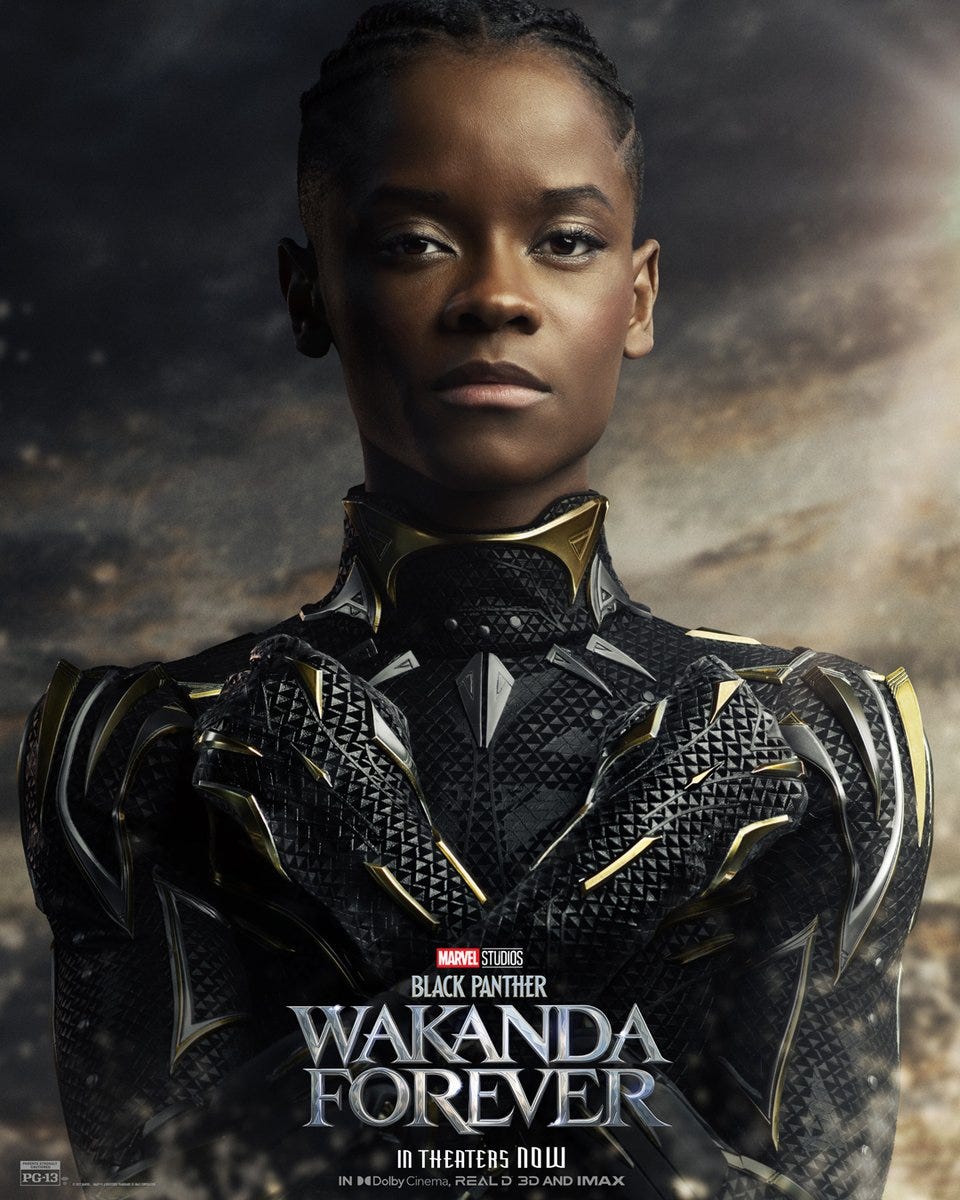
And this is what I am thinking about this year: Wakanda Forever. (and Tax season. And what it means to exist in a community, and what it means to be a teacher in various types of environments—what is teaching and how does it exist in relationship to learning. And homeschooling (the thing I have learned in this journey is that the first step is actually for a parent like me to deschool. whoops!))
But, Wakanda Forever.
~~~~~~~~~~~Spoilers ahead spoilers ahead spoilers ahead~~~~~~~~~~~~~~~~
Here are my thoughts in no particular order, a fast fish, if you will.
It’s a beautiful meditation on grief and how grief lives within a community. How it can fester like a sore. Shuri and Namor are obviously mirrors of one another (and how much clearer did they need it to make? Seriously people. That last battle scene where they both see their mothers and the way they got there, to that moment, spear to throat? (Spear in one’s gut))
The rarely desired true results of anger, bitterness, and resentment
Loneliness. I posit that both Shuri and Namor are terribly lonely people and their pain grounds them. Where is Shuri’s friend group in the way we saw T’Challa’s? Look at how stiffly she moved through the campus. Look at how she and Riri cleaved to one another. This is an isolated woman looking for connection.
Namor lives outside of Talokan (from what we saw). He can live easily on land or water. He’s got little wings, man. This dude is a part and separate. And he is different in other ways from the rest of the Talokanils. I’m sure you could offer “manipulation” as for why he offered Shuri his trauma at their meeting (that’s the cynical reading), but this one was someone who saw another grieving person and offered a method for sympathy and discourse.
It is a beautiful meditation on grief and daughter-mother relationships.
What does it mean to be a mother? What does it mean to be a daughter and be the both the upholder of legacy and the person who forages a new path? (Especially for Shuri who routinely thwarts Wakandan tradition)
Ramonda's words "show him who you are" offer Shuri a path back to re-connection in a way that the heart shaped herb--taken by mostly men before her--could not.
It is thinking so clearly about what it means for a mother and daughter to navigate loss, to carry forward, and how a mother imparts her wisdom and legacy—and how a child can refuse it.
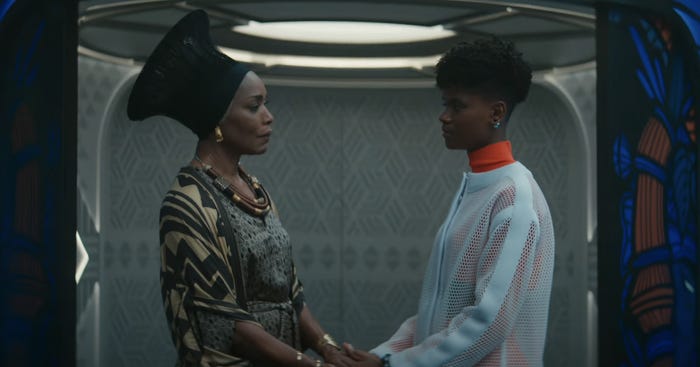
It is a beautiful meditation on grief, and mother-daughter relationships that is unfortunately stuck in a Marvel film.
Look, there are issues with Huckleberry Finn. And some of the issues lay smack in the last fifth, because it is ill-fighting. I have always argued it is because Huck is our narrator and because he’s willing to change his viewpoint, he stops participating in the world. He becomes a passive viewer of his own story. Lameo Tom Sawyer drives the rest of the narrative.
This is because, as far as Huck is concerned, he is dead already. There’s no point in going on anymore because he’s consigned himself to hell for Jim.
The narrative falls apart because the narrator falls apart and Mark Twain is trying to shoe-in a boy’s book into a novel that is a moral examination of community and love.
Wakanda Forever is a smart film that must constrain itself to Marvel’s requirements. A Marvel film is beautiful to look at it and it’s violent. Everyone is beautiful and no one has sex (1) and no one is a vehicle for desire (I have so many thoughts on the Beauty and the Beast parallels on Namor/Shuri but that’s for later, or maybe not).
The mutation of grief and regret into rebirth of Shuri into the Black Panther isn’t given an iota of space. Her seeing Killmonger is so critical and it needs space for her to resolve it. But no, she’s in her suit and she’s ready to shout at the council and get to war. ( A war that people tell her is ill-advised). We get that Shuri is running from herself, and the possibilities of herself, from the legacy of cannibalizing grief, but not to even investigate it?
This woman is an investigator. She asks good questions. She researches. How does a fight allow her to reconcile? (We could argue that her figuring out how to weaken Namor is a reconciliation of her prior self, a re-connection to the feminine in the Heroine’s journey, but then the taking of the heart shaped herb would be the healing of the mother/daughter split and it only widens it).
But Marvel movies demand a big fight scene. It demands a blood (despite it being relatively bloodless) sacrifice (as someone on twitter said about the Eternals, they want R rated Marvel films for the violence, not the sex).
Also, a Marvel movie follows Campbell’s hero’s journey and that is an ill-fitting suit for Shuri. (And there’s never any reconciliation with the elixir back to the community, anyways. It’s always a skip and a cycle back to the next call).
I might argue that this film is more interested in that healing within the community, especially as it relates to Shuri’s discovery in Haiti. And this moment, in a mid-credits scene—is actually how Shuri finalizes integrating the masculine and feminine. In the mid-credits scene!
Marvel movies are interested in spectacle. This film is not. The shoehorned spectacle detracts from the tale it is trying to tell. And that’s why it feels unsatisfying.
This is where people usually go, well then how would you do it? Ryan Coogler said he had multiple scripts, including one with a nascent romance between Namor and Shuri. Love, emergent love, radical love, is the way to breach the gaps between communities. (Think of Peeta, his first interview. He was encouraged to rip apart Katniss, unlikable Katniss. It would have been so easy. What does he offer? Love. A story of unlikely connection and tenderness).
But, of course, Marvel has its own stories it needs to tell and where does love fit in it? Nowhere.
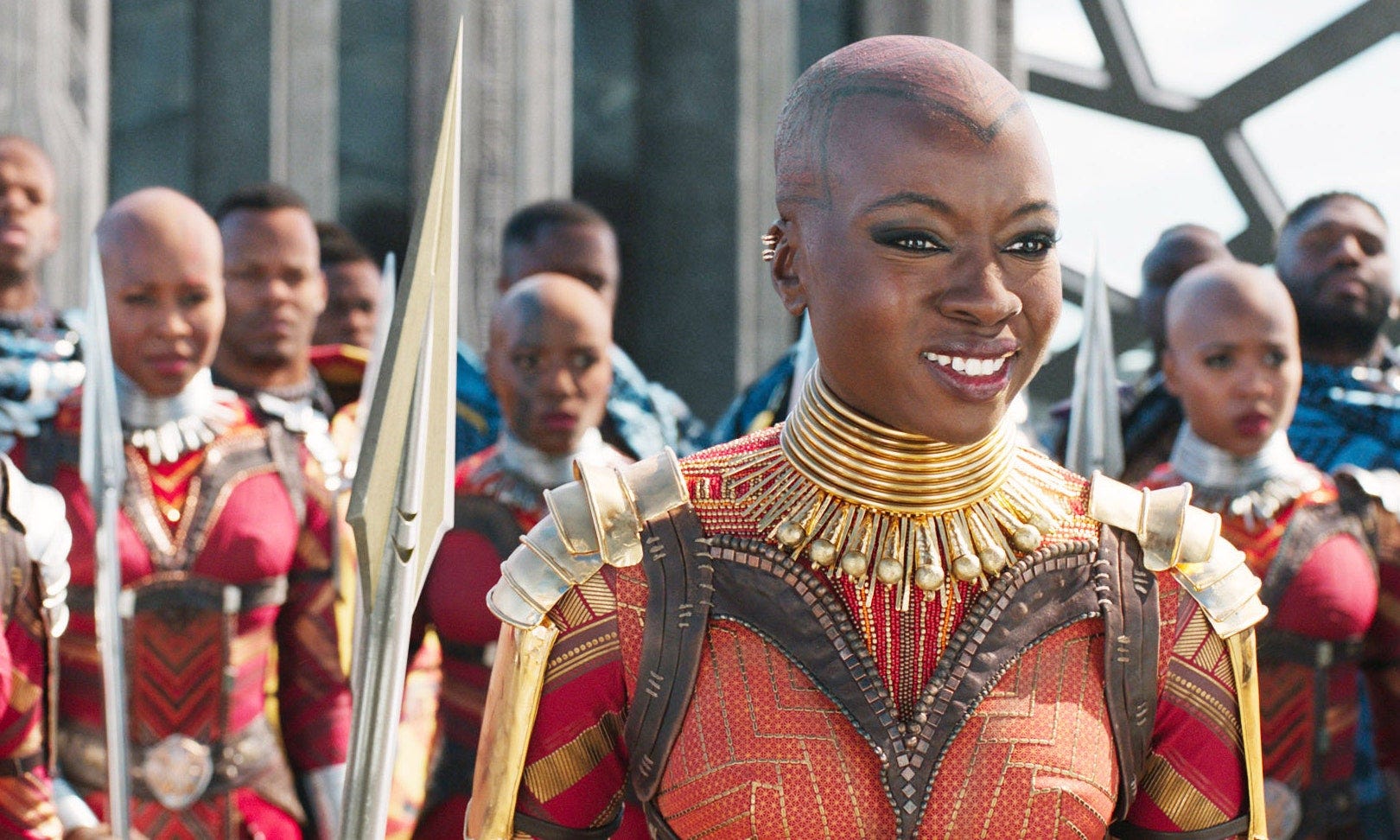
All the couples break up. The only one that happens is when Steve rewrites history to go back to be with his love, which is a radical departure from his character. Ultimately, neither Shuri nor Namor have completed their journey toward healing, although perhaps they are both on their way now. The narrative feels unfinished; that final, extensive battle was drawn out and told the wrong stories (although I did enjoy Okoye beating Attuma).
I also have some thoughts about the state of violence and who decides something counts as violence, as seen through Killmonger and Namor and Shuri, and Foucault, but this feels too long and meandering. In short, Wakanda Forever is a clever film, a provocative film, a gorgeous film (a great soundtrack), made less than what it could have been because of the demands of a Marvel film.
Also, everyone read this (1): Everyone is Beautiful and No one is Horny. It’s why I think love, romantic love, can never be the answer in Marvel.
Til my next rambling one, may you find comfort in these uncertain times and, really, the Wakanda Forever soundtrack is amazing (the podcast with Ta-Nehisi Coates is also out now wherever you listen to podcasts).
Thanks for reading Get in loser we're going ficcing ! Subscribe for free to receive new posts and support my work.


