Functionally, an Explainer

CW: mentions of experience with ableism and ableist rhetoric
This is not meant to be all incluslive, but as an explainer to people who may have heard the terms and wondered what they meant and why the autistic community does not like functioning labels.
Thanks for reading Get in loser we're going ficcing ! Subscribe for free to receive new posts and support my work.
July is disability pride and awareness month. I am ADHD with self dxed Autism (AuADHD). I say self-diagnosed because while my doctor would allow that I do have ADHD most likely, there is no way that a someone like me—a mother, a wife, a successful professional—could have autism. I handflap, bruh. I often have no idea what to do next in a social situation. But I can maintain eye contact!
And this is why we need disability awareness, in addition to pride and promotion. One of the most intransient things that I come up against are functioning labels and autism levels. “My child is high functioning.” While I have many thoughts about how these labels are used to make neurotypical (NT) parents feel comfortable, these labels are actively harmful toward autistic people.
In order to break down the inutility and ableism in this, let me provide the following explainers:
Dysregulation refers to the body’s inability to regulate itself. This could from keeping a stable temperature to not being able to gauge an emotional response. For example, a pencil breaks. An NT person might go this is a minor inconvenience and then get a new pencil or sharpen the broken one, depending on how it broke. For someone with emotional dysregulation, this could be a major speed bump and they could cry or yell or be unable to move forward.
Executive functioning(EF) refers to the skills to be able to plan, focus attention, and juggle multiple tasks. EF relies on self-regulation to be able to succeed. EF relies on working memory and flexible thinking as well (and this is where people with ADHD get off track—if that working memory isn’t helping move things to the permanent memory, executive functioning is always being relearned or steps are always being re-done).
For example, as an employee, I log on to my program, I check my email, I set up the other programs I’ll need for the day and I’m able to prioritize what needs to be done first. If I don’t know, I can ask a co-worker or supervisor. Children learn EF skills from parents, pre-schools, and in kindergarten. They learn how to come in and set up their desk and put their coats and bags away.
But what if you’re wearing a particularly itchy shirt one day or your shoes don’t fit properly? Or your routine was broken in the morning? Then it might become difficult to understand how to break down next steps. Or not be grouchy and discombobulated. That is why EF is important.
This leads us all to functioning labels. 1, 2, or 3 or, more frequently, high functioning or low-functioning. Being high functioning is intended to be praise. It means the person is able to function well in society and to meet NT ideas of how a person looks and behaves. Their struggles are minor.
Low functioning means a person who struggles to fit into NT ideas of how a person looks and behaves. They may hand flap frequently or rock. They may have big outbursts of emotion as they try to self-regulate. They may rely on a speech program or motor devices, such as a wheelchair or crutches.
Functioning labels are generally ground in a person’s ability to verbally communicate, adapt to new situations, and manage their daily life independently.
Functioning labels are problematic for many reasons but two major ones are: they allow people to refuse accommodations and they see autism as a linear spectrum.
Let’s take the last one first. Rebecca Burgess created a wonderful story with graphics to explain the linear theory. From it, the Canadian Autism society created the graphic below, illustrated by Abby Zinman.
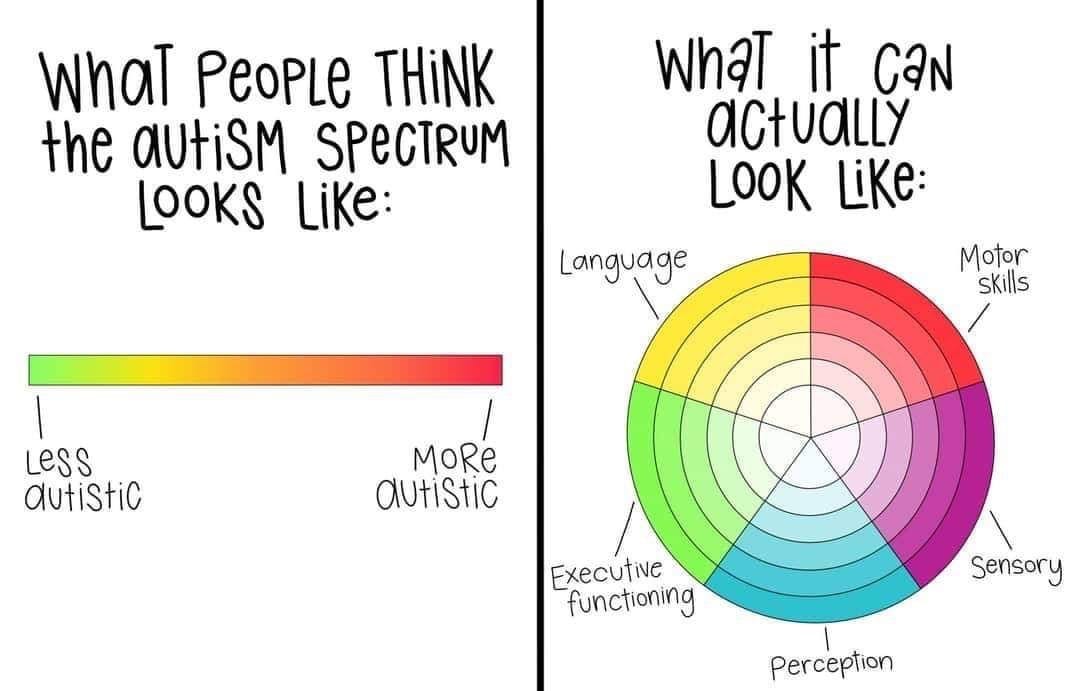
Functioning labels reduce autistic needs to a straight line—you’re either more or less autistic. But the argument Burgess makes is that it is more like a color wheel or, back in the day, those learning style charts that I think are out of fad. This is a simplified version of many skills, but it gets the point across. A person’s language skills might be quite high and perception skills low.
But because they are verbal, they are seen as high functioning, which might mean accommodations for sensory testing or a balance chair or more time in exams is denied. Functioning labels become a tool used to deny disabled people what they need. “Their highly verbal and social, they don’t need these things!” has been uttered in many an IEP meetings.
Another autistic person might love crowds, and find conversations difficult to navigate. Another person might have strong executive functioning skills and have many sensory needs which makes it difficult to use those EF skills, unless the sensory needs are met first.
Finally, functioning fluctuates. NT people also finds themselves not functioning well when they are sick or distressed. Their car goes flat and they can’t get to work and AAA is going to take several hours to get there. And they aren’t at home so its not as if they can’t just Uber to work. The ability to plan becomes more difficult as then does their emotional regulation.
For most people, the ability to function or complete tasks varies from day to day, even task to task, and depending on your needs and skill sets, some days it will be easy, and other days it won’t. But functioning labels are often used against people who might have been tested at their best. Or worst. “You spoke well in testing, why do you need an AAC device sometimes?” This person informed you of their needs—why is it so difficult to meet people where they are at?
Because of functioning labels. It’s easy to cram people into a box and, if someone is high functioning, its easier to earn the approbation of a NT society.
So what’s a better option? Describe a person with their needs. For example, highly verbal and with sensory sensitivites to loud noise and bright lights and sudden noises. Or social with strong executive functioning skills and uses AAC device to communicate. This gives a stronger picture of what accommodations a person needs and what environments in which they might flourish.
There’s more to be said here about why these labels exist, why neurotypical society needs them and why a capitalist society needs them, but that’s a different post and something upon which many autistic writers have contributed blog posts, articles, and books.
Next time you see a person who isn’t autistic using a functioning label, gentle remind them that the autistic community doesn’t like those and to request what needs are asking to be met. Disability should be part of every DEI initative and if you are part of one and don’t see disability included, now is the month to do so.

Thanks for reading Get in loser we're going ficcing ! Subscribe for free to receive new posts and support my work.